
Google Business Profile vs Business Directory: Do You Need Both?
A practical South African guide to understanding how Google Business Profile and online business directories differ, where they overlap and why one does not necessarily replace the other.
On this page
You create a Google Business Profile.
Your business can now potentially appear when people search on Google or Google Maps.
So you may reasonably ask:
Do I still need to list my business in an online business directory?
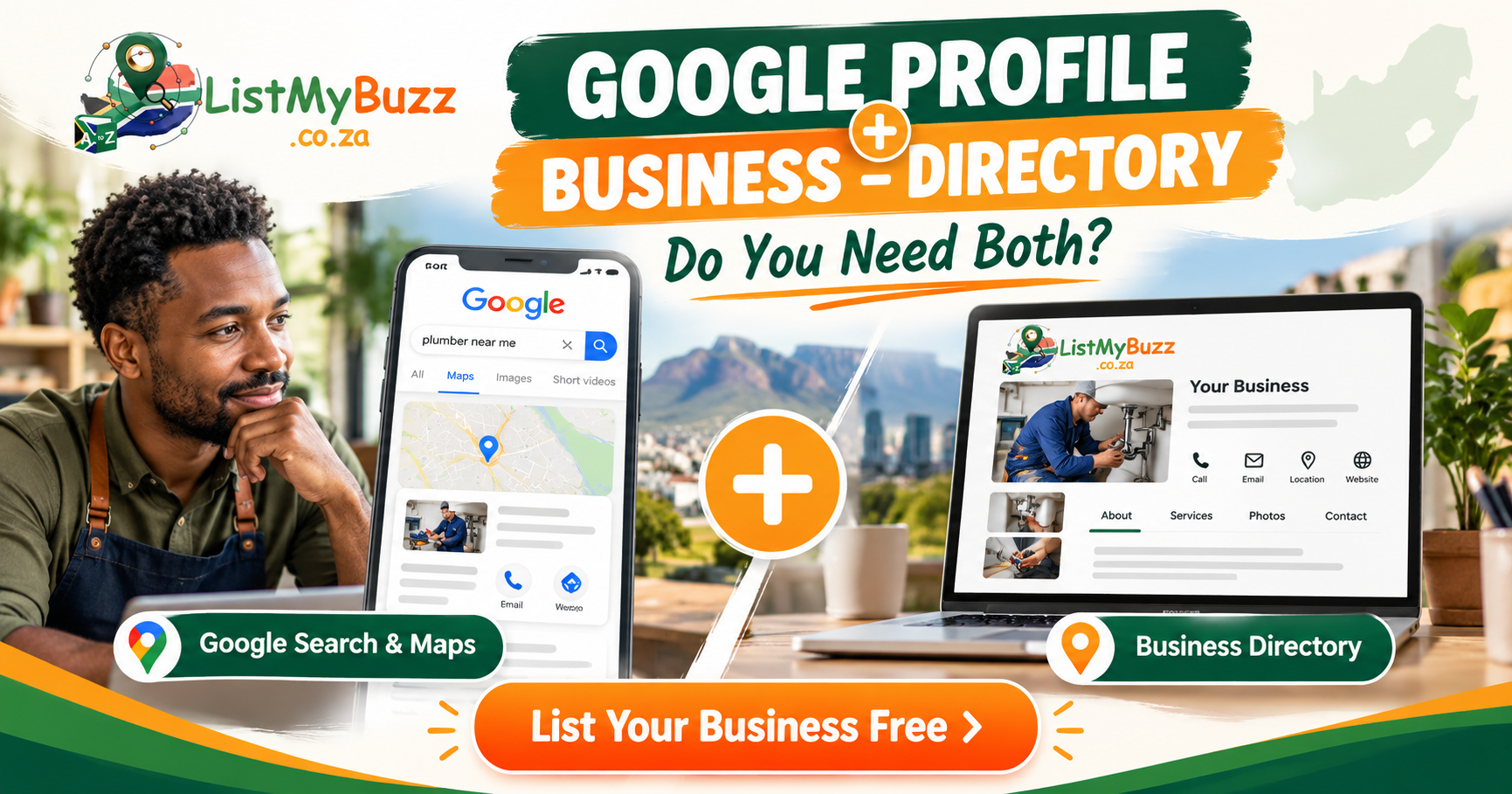
For many eligible local businesses, the two can work alongside each other because they serve different purposes.
A Google Business Profile manages how an eligible business appears across Google Search and Maps.
A business-directory listing creates another structured profile where people using that directory can discover your services, understand your business and find ways to contact you.
Neither one guarantees rankings, enquiries or customers.
And neither needs to replace the other.
Quick answer
If your business is eligible for Google Business Profile, it generally makes sense to maintain an accurate Google profile and establish useful profiles on relevant business directories.
Think of them this way:
Google Business Profile
Helps eligible local businesses appear and present information on Google Search and Maps.
Business directory
Provides another place where customers can search for businesses, browse categories or locations, compare available profiles and make contact.
On ListMyBuzz, for example, customers can currently search businesses by category and location, compare business profiles and contact businesses or use quote and booking functionality where available.
The objective is not to be listed everywhere. It is to maintain accurate, useful information in the places that are relevant to your customers.
In this guide
What is Google Business Profile?
Google Business Profile is Google's tool for eligible local businesses.
Google says businesses can add or claim an eligible Business Profile at no charge. Once added and verified, the profile can help customers find the business on Google Search and Maps.
A profile can contain information such as:
Google describes Business Profile as an online listing for local businesses on Search and Maps.
Who is eligible?
Not every organisation or online business qualifies. Google's current eligibility guidance says a business generally needs to make in-person contact with customers during its stated hours.
That can include:
Storefront businesses
Customers visit the business location.
Service-area businesses
The business travels to customers.
Google says online-only businesses without in-person customer contact are generally not eligible for a standard Business Profile.
Eligibility rules can change, so always check Google's current guidance rather than assuming your business qualifies.
What is an online business directory?
A business directory organises businesses into searchable profiles.
Depending on the platform, customers may browse according to:
A directory profile might contain:
ListMyBuzz is designed as a South African business directory and growth platform. Its core proposition is to help consumers find businesses while giving SMEs, service providers, retailers, tradespeople and professionals structured profiles through which they can present their businesses.
The live directory currently uses a simple customer journey:
Search → Compare → Contact
Customers can search local businesses, review available profiles and contact businesses directly or request quotes where functionality is available.
Google Business Profile vs business directory
Here is the simplest comparison.
| Feature | Google Business Profile | Business directory |
|---|---|---|
| Main environment | Google Search and Maps | Directory's website or platform |
| Primary purpose | Present an eligible local business on Google | Help customers discover and compare listed businesses |
| Cost | Google says eligible profiles can be added or claimed at no charge | Depends on the directory |
| Eligibility | Google eligibility rules apply | Depends on directory rules |
| Business details | Yes | Usually |
| Photos | Yes | Usually |
| Opening hours | Yes | Usually |
| Reviews | Google reviews | Depends on platform |
| Location information | Address or service area | Depends on platform |
| Customer discovery | Google local search and Maps | Directory search, categories and locations |
| Profile ownership | Managed through Google | Managed through directory account |
| Guaranteed rankings | No | No |
| Guaranteed customers | No | No |
Google says local results are primarily determined by relevance, distance and prominence, and explicitly says there is no way to request or pay for a better organic local ranking.
A directory listing therefore should not be marketed as a way to “buy” better Google rankings. Its value is different.
Do you need both?
For many eligible South African local businesses, using both can be useful. Not because having two profiles automatically produces better rankings. Because the profiles create different customer touchpoints.
Google helps people find you within Google
Imagine someone searches:
plumber near me
or:
hair salon in Randburg
Google may show Maps and local Business Profile results based on the search, the user's location and other ranking signals. That is where your Google Business Profile matters.
A directory creates another discovery route
Someone may instead browse a South African directory because they want to:
That is where a directory can play a different role.
Your website plays another role again
Your website gives you greater control over:
These assets can work together rather than competing.
A sensible online-presence structure might look like:
Integrated Digital Presence Framework
Google Business Profile
Primary local search & Google Maps discovery
Your website
Dedicated hub for brand trust, detailed services & conversions
ListMyBuzz or another relevant directory
Structured category discovery, verified profiles & quotes
Main social channels
Ongoing engagement, community updates & direct messaging
You do not need dozens of profiles. You need a manageable set of useful ones.
What does Google Business Profile do particularly well?
Google Search visibility
A Business Profile is integrated directly with Google Search. When someone searches for your business name or a relevant local service, eligible profiles may appear within Google's local experience.
Google Maps
This is one of its biggest differences from a standard directory. Customers can find eligible businesses through Google Maps, view directions and check local information.
Customer reviews
Customers can leave Google reviews, and business owners can respond. Google says review count and ratings can contribute to prominence, although they are only part of the broader local ranking system.
Current business information
Owners can manage details such as hours, phone numbers, website, address or service areas, photos and description. Google says complete and accurate information can make a business more likely to appear for relevant local searches.
Business updates
Google currently lets businesses publish certain updates, offers and events through Business Profile posts.
What can a business directory add?
A useful directory provides another organised discovery environment. That can matter because customers do not all search in exactly the same way.
Category browsing
Someone may not know a particular business name. They may simply want electricians, restaurants, guest houses, accountants or mechanics. A directory can help organise these businesses into categories.
Location-based discovery
A customer may be looking specifically within a particular town, suburb or province. ListMyBuzz currently positions its directory around category and location discovery.
A dedicated business profile
Your directory page can bring several pieces of information into one place. On ListMyBuzz, current listing features include fields and options for business descriptions, addresses, phone numbers, emails, websites, profile and cover images, social links, opening hours, additional images and map configuration.
A shareable listing
A business-directory profile can also become another link you share with customers through WhatsApp, social media, email, quotations, business cards and marketing material.
Directory-specific actions
Depending on the platform and package, directories can provide features that differ from Google. ListMyBuzz currently includes direct profile discovery and selected quote, enquiry and growth features, with additional functionality varying by package.
Treat directory listings as part of your broader digital presence, not as an SEO shortcut.
Does listing in a directory improve your Google ranking?
This needs a careful answer.
A directory listing does not guarantee that your Google ranking will improve.
Google states that local ranking is mainly based on:
Relevance
How closely a business matches the search.
Distance
How far the business is from the searcher or searched location.
Prominence
How well known or established the business appears to be.
Google also notes that prominence can use information from across the web.
That does not mean:
“Create a directory listing and you will rank higher.”
The practical value of a legitimate directory profile is that it gives your business:
Treat directory listings as part of your broader digital presence, not as an SEO shortcut. The existing ListMyBuzz Google guide follows the same principle: it recommends relevant South African directories but explicitly warns that directory listings do not guarantee Google rankings.
Keep your information consistent across both profiles
This may be more important than simply creating another account. Suppose Google shows:
Google shows
ABC Plumbing — 082 123 4567 — Benoni
Directory shows
ABC Plumbing Services SA — 083 999 1234 — Boksburg
A customer may wonder whether these are the same business. Keep your core business information accurate and reasonably consistent.
Business name
Use the genuine name customers recognise. Google specifically advises businesses to represent themselves consistently with their real-world branding and not manipulate the business name.
Phone number
Use a current number that someone monitors.
Website
Make sure both profiles link to the correct website.
Location
Use an accurate address or service area. Google specifically requires accurate address and service-area information.
Opening hours
Update both when your schedule changes.
Services
Make sure discontinued services are removed and new ones are reflected where appropriate.
Create a master business-information sheet
One of the easiest ways to maintain consistency is to keep one source document. Include:
Use this document whenever you update:
This does not mean every description must be word-for-word identical. It means the underlying facts should agree.
Which should you create first?
If you run an eligible local business and currently have neither profile, I would treat the process in this order.
Confirm your core business information
Before creating anything, write down your correct:
Create or claim your Google Business Profile
For an eligible storefront or service-area business, Google Business Profile is an important foundational local presence because it connects directly with Google Search and Maps. Google allows eligible businesses to add or claim their profile at no charge.
Create a relevant business-directory listing
Give customers another place to discover and understand the business. South African businesses can currently start with a Free Buzz profile on ListMyBuzz at R0, according to the live package page.
Connect both to your website
If you have a website, make sure it contains the same current business details.
Review everything regularly
A profile that was correct three years ago may be wrong today.
What if your business is not eligible for Google Business Profile?
This is an important difference.
Google says standard Business Profiles are intended for businesses that make face-to-face contact with customers, whether at a storefront or by travelling to the customer. Online-only businesses generally do not qualify.
That does not mean an online-only business should have no digital presence. It can still use appropriate channels such as:
Do not fake eligibility
Always check the eligibility requirements of each platform. Do not create a fake storefront or false address simply to qualify for Google Business Profile.
Common mistakes when using both
Creating conflicting information
Different phone numbers, addresses and hours confuse customers. Better approach: keep one approved master set of business details.
Keyword stuffing your Google business name
Do not rename Mokoena Plumbing to Mokoena Plumbing Best Emergency Plumber Johannesburg Geyser Expert unless those words genuinely form part of the real-world business name. Google's guidelines say businesses should represent themselves consistently as they are known in the real world.
Expecting the directory to replace Google
A ListMyBuzz profile does not replace a Google Business Profile for an eligible local business. They operate in different environments.
Expecting Google to replace every other profile
The reverse is also true. A Google Business Profile does not automatically create a presence within independent South African directories.
Creating dozens of low-quality listings
More is not automatically better. Prioritise platforms that are relevant, maintained, appropriate to your industry or location, easy to update and useful to actual customers.
Creating profiles and abandoning them
Schedule regular checks. Update information when you move, your phone changes, your hours change, your services change, your website changes or your service area changes.
Google Business Profile and ListMyBuzz: a practical example
Imagine a mobile electrician operating in Pretoria.
On Google Business Profile
The business may provide:
Business name: Tshwane Electrical Services
Category: Electrician
Service area: Pretoria and selected surrounding areas
Phone number: Current business line
Hours: Current operating hours
Photos: Completed work and business imagery
Eligible customers may encounter the profile through Google Search or Maps.
On ListMyBuzz
The business might create another structured profile containing:
Business name
Service category
Operating areas
Description
Contact information
Website
Photos
Opening hours
Customers browsing the directory now have another way to discover and evaluate the same business. The information should agree across both platforms.
Which one is more important?
The question is less useful than: Which platforms are important to my customers?
For an eligible local business, Google Business Profile is difficult to ignore because it operates directly within Google Search and Maps. But that does not make every other online presence unnecessary.
A strong digital footprint can include:
Google Business Profile
for Search and Maps.
Your website
for detailed information and brand control.
A relevant business directory
for another discovery and profile channel.
Social media
for ongoing communication and content.
A practical setup checklist
Before publishing, make sure you can answer yes to these questions:
Core information
Google Business Profile
Directory listing
Consistency
Maintenance
Frequently asked questions
The bottom line
The bottom line
Google Business Profile and a business directory are not the same thing.
Google Business Profile helps eligible local businesses manage how they appear within Google Search and Maps. A business directory creates another environment in which customers can discover businesses, compare available information and make contact.
For many South African SMEs, the practical answer is therefore not:
Google or a directory?
It is:
Use the right combination of accurate profiles that your customers actually use.
Start with accurate business information.
Create the important profiles.
Connect them to your website where appropriate.
Then keep everything updated.
Give customers another way to discover your business
Give customers another way to discover your business
Create a ListMyBuzz profile with your essential business information, services, contact details and images.
Neither Google Business Profile nor a business-directory listing guarantees rankings, enquiries, customers, sales or revenue. Results depend on factors including eligibility, search context, location, competition, information quality and customer demand.