
On this page
You send a quotation. The customer says: "Thanks, I'll have a look." Then nothing.
One day passes. Then three. Then a week.
Now you have a decision to make.
Do you follow up?
Or do you leave them alone because you don't want to sound desperate?
Many small-business owners struggle with this.
Follow up too little and genuine opportunities may simply be forgotten. Follow up too aggressively and the customer may start avoiding you.
The goal is neither silence nor pressure. It is helpful, relevant follow-up.
Quick answer
A good customer follow-up should usually do one of three things:
Confirm that the customer received what they asked for.
Help by answering a question or making the next step easier.
Clarify whether they still need your service.
It should not make the customer feel cornered.
A simple principle is: give the customer a reason for the message, make the next step easy and give them room to say no.
There is no universal number of follow-ups or perfect timetable for every business. A burst geyser, wedding photography enquiry, accounting proposal and corporate construction tender all have very different decision cycles. Your follow-up process should match the type of enquiry.
Why customers don't always reply
Silence does not automatically mean rejection. The customer may be:
Your follow-up should help distinguish between these possibilities. The purpose is not to pressure someone into buying. It is to make it easier for a genuinely interested customer to continue the conversation.
The difference between follow-up and chasing
These two approaches feel very different.
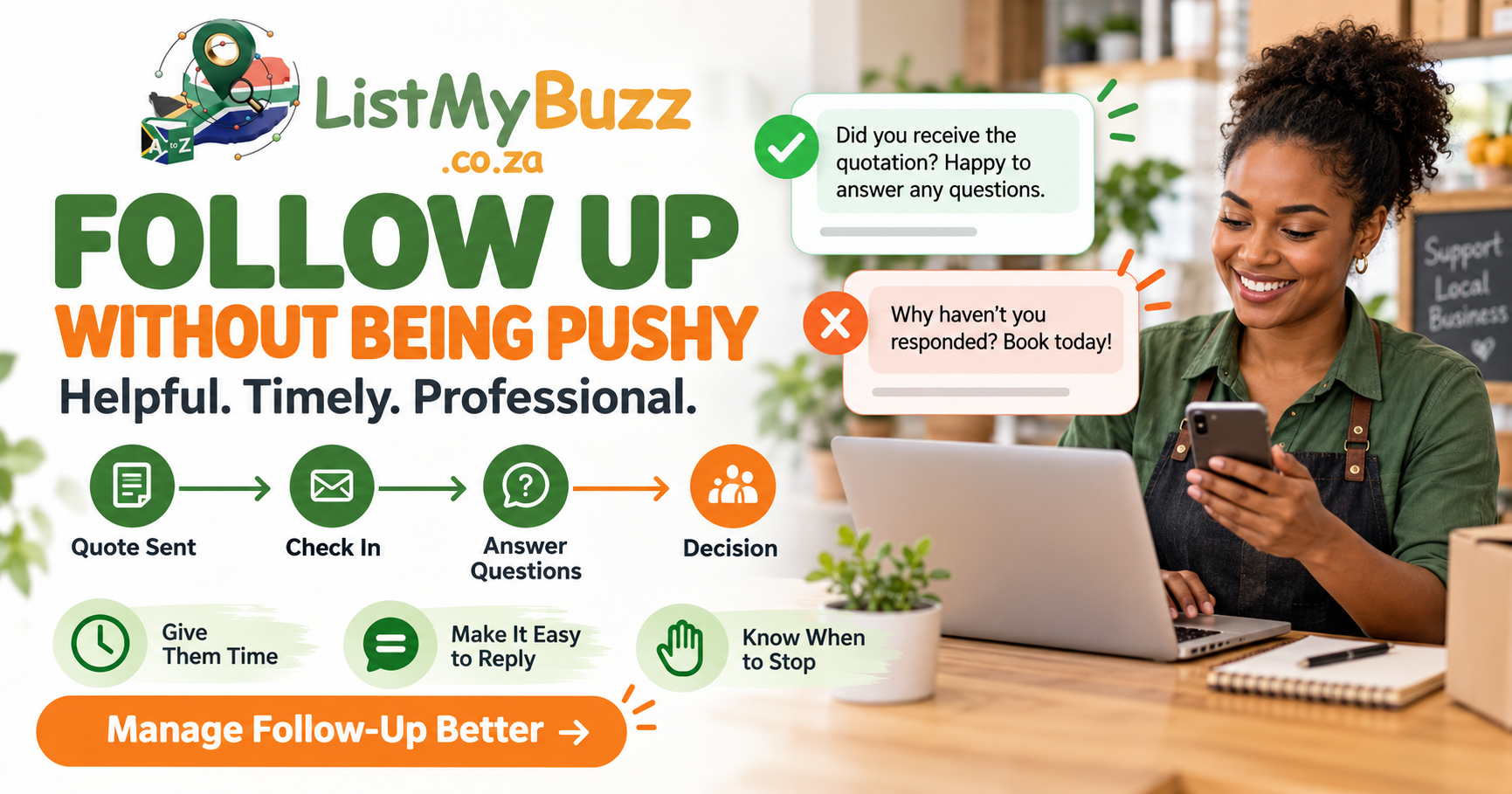
Helpful follow-up
"Hi Sarah, just checking that you received the quotation we sent yesterday. Please let me know if you'd like anything clarified."
Pushy follow-up
"Hi Sarah. Why haven't you responded? We need an answer today. This offer won't be available forever."
The first message has a useful purpose. The second creates pressure without knowing the customer's circumstances.
A professional follow-up should usually be:
Start by understanding where the customer is in the process.
Start by understanding where the customer is in the process
Not every potential customer needs the same message.
Someone who has just asked: "Do you service Benoni?" is at a different stage from someone who has already:
Before following up, ask:
What has already happened?
What is currently preventing the next step?
Then send a message that fits that stage.
A simple follow-up journey
A practical small-business process might look like:
Follow-Up Journey
New enquiry
Initial response
Information gathered
Quote or recommendation sent
Confirmation follow-up
Decision follow-up
Booked / declined / postponed / no response
This is more useful than sending the same: "Just following up..." message repeatedly.
Nine principles for better follow-up
Follow up because something useful needs to happen
Every follow-up should have a reason. Instead of: "Just following up." Try:
"Hi Peter, just checking that the quotation for the gate repair reached you. Let me know if you'd like us to clarify any of the items before you decide."
"Hi Nomsa, the Wednesday 10:00 appointment we discussed is still available at the moment. Would you like me to reserve it for you?"
"Hi David, you mentioned that you'd confirm after speaking to your landlord. Do you still need us to keep the plumbing assessment open?"
Each message moves the conversation forward without demanding a purchase.
Don't follow up five minutes after sending the quote
Give customers time to read and think. A practical starting point for many non-urgent enquiries could be:
| Stage | Possible approach |
|---|---|
| Quote sent | Give the customer time to review it |
| Next business day | Confirm receipt if needed |
| A few business days later | Ask whether anything needs clarification |
| Later follow-up | Ask whether the enquiry should remain open |
| No response | Close or pause the enquiry |
This is not a universal timetable. It is a starting framework. For an urgent repair job, the entire decision may happen within hours. For a large corporate proposal, the customer may need several weeks. Use the context of the enquiry.
Confirm receipt before trying to close the sale
Sometimes the customer hasn't rejected the quotation. They simply never saw it. Email can land in spam. A WhatsApp attachment can be overlooked. A quotation may have gone to the wrong address.
Before asking: "Have you decided?" consider asking: "Did you receive it?"
"Hi Lerato, just checking that the quotation we sent yesterday reached you successfully. If you'd like anything explained or adjusted, please let us know."
This feels more helpful because it solves a potential communication problem.
Make your message easy to answer
Long follow-up messages create work for the customer. Keep routine follow-ups simple.
Instead of
"Good afternoon. I hope you're well. I am contacting you with regard to the quotation we forwarded on Monday and would like to know whether you have had the opportunity to review all aspects of the proposal..."
Try
"Hi Kabelo, did you get a chance to review Monday's quotation? Happy to answer any questions."
The customer can answer quickly.
Use the customer's original enquiry
Relevant follow-up feels less intrusive. Suppose the customer asked for a geyser replacement quote. Follow up about that geyser.
Don't immediately switch to: "By the way, we also do bathroom renovations, drain cleaning, solar installation and maintenance plans."
Stay focused on what they asked about. You can introduce other services later when they are genuinely relevant.
Answer the question they may be afraid to ask
Sometimes customers disappear because something is unclear. Common concerns include:
"Hi Michael, just checking whether you had any questions about what is included in the quotation. I'm happy to break down the scope if that would help."
This creates a conversation instead of demanding a decision.
Don't use fake urgency
Avoid creating pressure that isn't real. For example: "You must book today or lose your chance!" is inappropriate if the appointment is actually available next week.
If there is a real deadline, explain it accurately.
Genuine availability example
"The Friday morning slot we discussed is still open at the moment. If you'd like it, let me know and I'll confirm the booking."
Genuine quote-validity example
"The quotation is valid until 18 October because supplier pricing may change after that date."
Only use urgency when it reflects a real operational constraint. The ListMyBuzz brand standards specifically avoid manipulative urgency and unsupported sales claims.
Give the customer permission to say no
This can make follow-up feel considerably less awkward.
"Hi Thandi, just checking whether you still need help with the website project. If your plans have changed, no problem. Just let me know and I'll close the enquiry on our side."
This does three useful things. It reminds the customer. It gives them an easy response. It allows your business to stop carrying an old enquiry indefinitely.
Sometimes a clear no is more useful than weeks of silence.
Know when to stop
More messages do not automatically create more sales. If the customer has clearly declined, asked you not to contact them, chosen another supplier, or simply stopped responding after reasonable attempts, move the enquiry to an appropriate status.
That could be:
Follow up later, only where the customer has actually indicated that would be useful. The purpose of a customer pipeline is not to keep every lead alive forever. It is to know what is actually happening.
Follow-up message examples you can adapt
After sending a quote
Hi Sipho, just checking that you received the quotation we sent yesterday. Let me know if there's anything you'd like clarified.
After the customer says they'll think about it
Hi Priya, you mentioned you'd have a look at the proposal this week. Do you have any questions I can help with before you decide?
When availability matters
Hi Naledi, the Thursday afternoon appointment we discussed is still available. Would you like me to reserve it for you?
After several days of silence
Hi John, just checking whether you still need assistance with the electrical work. If your plans have changed, no problem. Let me know and I'll update the enquiry on our side.
When the customer asked you to contact them later
Hi Lerato, you asked me to check back with you this week about the catering quotation. Are you ready to continue, or would another time be better?
Final close-out message
Hi Themba, I haven't heard back regarding the quotation, so I'll close the enquiry for now. If you'd like to continue later, you're welcome to contact us again.
Notice the tone. There is no guilt. No fake scarcity. No demand for an explanation.
Should you follow up by phone, WhatsApp or email?
Use the channel that makes sense for the conversation and the customer's reasonable expectations.
Phone
Useful when:
Useful for:
Useful for:
You don't necessarily need to contact the same customer on all three channels. Sending an email, then a WhatsApp, then an SMS, then calling, all within an hour can feel overwhelming. Choose the appropriate channel.
Keep notes so the customer doesn't have to repeat everything
Follow-up becomes frustrating when every message starts from zero. If a customer has already told you the suburb, the service required, the date, the budget, or the problem, record it.
Then your follow-up can say:
Instead of
"Remind me what you needed again?"
You can say
"Hi Zanele, following up on the catering enquiry for 40 guests in Midrand on 24 October..."
This is one reason organised enquiry records become valuable as a business grows.
Your CRM should tell you who needs follow-up
A CRM or organised customer tracker can help you see:
That removes some of the emotional awkwardness from follow-up. Instead of thinking: "Should I randomly message this customer again?" you have a defined process.
CRM Follow-Up Pipeline
Quote Sent
Follow-Up Due
Customer Responded
Booked / Declined / Pending
ListMyBuzz's current Growth Tools include CRM workflows, email and SMS sequences, reminders, internal notifications and opportunity tracking designed to support more organised enquiry follow-up.
Automation can help, but the message still matters
ListMyBuzz currently supports automated follow-up workflows that can trigger email or SMS messages after a lead is captured or a call is missed, alongside CRM tracking and reminders. That can reduce repetitive admin.
But automation does not make a bad follow-up strategy good.
An automated message can still be:
The workflow should reflect your actual customer journey. Good automation helps the business remember. It should not make the customer feel hunted.
A simple follow-up system for a small business
You can start without complicated software. For each enquiry, record:
| Field | Example |
|---|---|
| Customer | Thandi M. |
| Enquiry | Kitchen plumbing |
| Source | ListMyBuzz |
| Quote sent | 6 October |
| Status | Quote Sent |
| Next action | Follow up |
| Due | 8 October |
| Owner | Kabelo |
| Result | Pending |
Then review the list at a fixed time each day. For example:
The exact routine depends on your business. The important thing is that follow-up happens because of a process, not because somebody suddenly remembers.
What about POPIA?
This is where businesses need to distinguish between responding to a customer's enquiry and using someone's contact information for unrelated ongoing marketing.
Do not assume that because someone asked for one quote, you now have unlimited permission to send them promotional messages indefinitely.
The Information Regulator's current direct-marketing guidance says unsolicited electronic direct marketing to a person who is not already a customer generally requires consent. It also places conditions on direct marketing to existing customers, including that the contact details were obtained in the context of a sale, the marketing relates to the organisation's own similar products or services and the person has a reasonable opportunity to object.
The guidance covers electronic channels including telephone, email, SMS and certain direct messaging.
A useful practical distinction
Following up with: "You asked us for a plumbing quotation yesterday. Did you receive it?" is directly connected to the customer's enquiry.
Adding that person's number to a recurring promotional campaign for unrelated offers is a different matter.
If you run ongoing email, SMS, WhatsApp or telemarketing campaigns, review the Information Regulator's current guidance and obtain professional legal or compliance advice where necessary.
Don't disguise marketing as customer service
This can happen easily.
A customer asks: "How much is an aircon service?" You respond.
Two months later they are still receiving: "SPECIAL OFFER!!! DON'T MISS OUT!!! LAST CHANCE!!!"
That is no longer simply helping with the original enquiry. Keep transaction or enquiry-related communication separate from ongoing marketing campaigns.
Your CRM should ideally help you distinguish between:
What if someone says "contact me next month"?
Record it. Don't contact them every week until then.
If the customer says: "We're waiting for the new financial year. Contact me in April."
The useful action is: Create an April reminder.
The unhelpful action is: Send three March messages asking whether anything has changed.
Respecting timing is part of professional follow-up.
What if the customer says your quote is too expensive?
Do not immediately start discounting.
Ask whether clarification would help.
"Thanks for letting me know. If useful, I can explain what is included in the quotation so you can compare the scope accurately."
If there is a legitimate lower-cost option, explain it. But don't pressure the customer. Sometimes the correct outcome is: "Thanks for considering us. I understand."
Not every enquiry needs to become a sale.
What if they chose a competitor?
Respond professionally.
"Thanks for letting me know. I appreciate the update, and I hope the project goes well."
There is no benefit in arguing.
You may even want to record the reason when the customer voluntarily shares it:
Follow-up should match the value and complexity of the decision
A R300 service and a R300,000 project should not have identical follow-up processes.
A customer choosing a basic appointment may decide quickly. A business evaluating a major contract may need:
For more complex sales, follow-up may focus less on: "Are you ready to buy?" and more on: "Is there any additional information your team needs to evaluate the proposal?"
Match the conversation to the decision.
Build follow-up around customer signals
Useful signals include:
Customer asks about availability: They're likely considering timing. Respond with practical options.
Customer asks for an amended quote: There is still an active decision. Send the revision and record the next step.
Customer says "I'll contact you": Give them reasonable space.
Customer says "Not interested": Close the enquiry.
Customer asks you to follow up on a date: Create a task for that date.
When professional automation support can help
A simple business may only need a spreadsheet and reminders. But as enquiry volume grows, the challenge may become connecting:
This is where implementation becomes more technical.
DMA101 is a supporting digital-growth partner for businesses that need help designing and implementing a connected CRM and follow-up system. Its current services include CRM setup, lead pipelines, forms, tags, email and SMS automation, reminders, task flows, missed-call text-back and automated lead-nurture workflows.
That support can become relevant when your problem changes from: "I need to remember to follow up." to: "I need our website, CRM, messages, bookings and team follow-up to work together."
ListMyBuzz remains the directory, discovery and business-growth platform. DMA101 can assist with broader implementation where a more customised system is required, which follows the approved ListMyBuzz partner positioning.
A practical follow-up framework
Before sending another message, ask four questions.
Is it relevant?
Am I following up about something the customer actually asked for?
Is it useful?
Does the message clarify, confirm or make the next step easier?
Is the timing reasonable?
Has the customer had enough time to consider the information?
Can they easily decline?
Have I given the person room to say no or close the conversation?
If the answer to all four is yes, your follow-up is less likely to feel pushy.
Frequently asked questions
The bottom line
The bottom line
Following up does not have to feel pushy.
Good follow-up is simply good customer communication.
Remember what the person asked for.
Give them time.
Check whether they received what you sent.
Answer questions.
Make the next step clear.
Let them say no.
And know when to close the conversation.
As your enquiry volume grows, move away from relying entirely on memory. Use statuses. Use reminders. Use a simple pipeline. Automate repetitive administration when it genuinely helps.
The goal isn't to chase every potential customer until they surrender. It is to make sure genuinely interested customers do not get forgotten while respecting the people who decide not to proceed.
Need a more organised way to manage follow-up?
Need a more organised way to manage follow-up?
ListMyBuzz Growth Tools include CRM workflows, reminders, customer communication, booking tools and selected email and SMS automation designed to support more consistent enquiry management.
Customer follow-up, CRM systems and automation do not guarantee enquiries, bookings, customers, sales or revenue. Results depend on the customer's needs and decisions, as well as pricing, demand, service quality, implementation and other business factors.