
How Much Should a Small Business Spend on Marketing?
There is no single marketing percentage that is right for every small business. A better budget starts with what your business can afford, what a customer is worth and what your marketing is actually producing.

There is no single marketing percentage that is right for every small business. A better budget starts with what your business can afford, what a customer is worth and what your marketing is actually producing.
Ask:
"How much should I spend on marketing?"
and you will often hear a percentage of revenue.
It sounds convenient.
Take your turnover.
Multiply it by a percentage.
That becomes your marketing budget.
The problem is that two businesses with identical turnover can have completely different:
A plumbing company, guest house, accounting firm, restaurant and online retailer should not automatically spend the same percentage simply because they generate similar revenue.
A more useful question is:
How much can my business sustainably spend to generate the customers it actually wants?
Quick answer
There is no universal marketing-budget percentage that every small business should follow.
A practical budget should consider five things:
| Factor | Question |
|---|---|
| Profitability | How much gross profit does the business generate? |
| Cash flow | How much cash can safely be committed before the marketing pays back? |
| Customer acquisition cost | What does a new customer currently cost? |
| Growth target | How many additional customers are you trying to acquire? |
| Capacity | Can the business actually serve the extra demand? |
A useful starting formula is:
Target new customers × affordable cost per customer = potential acquisition budget
Then check that figure against your cash flow, operating expenses and capacity.
Marketing should help the business grow.
It should not create a cash-flow problem simply because someone online recommended a percentage.
In this guide
- 1.Why there is no perfect marketing percentage
- 2.What should count as marketing spend
- 3.Start with profit margin and cash flow
- 4.Use cost per customer to build your budget
- 5.Set a marketing budget from your growth target
- 6.How to use a percentage of revenue carefully
- 7.Marketing budgets for new businesses
- 8.How to divide your budget between channels
- 9.How much should go to testing
- 10.Why capacity matters
- 11.Signs you may be spending too little
- 12.Signs you may be spending too much
- 13.Three practical small-business examples
- 14.How to review your marketing budget monthly
- 15.Where ListMyBuzz tools can help
- 16.Marketing-budget checklist
- 17.Frequently asked questions
- 18.The bottom line
Why there is no perfect marketing percentage
Consider two businesses.
Both generate:
R100,000 in monthly revenue
But Business A may sell a high-margin professional service.
Business B may resell products with significant stock and delivery costs.
Their revenue is identical.
Their ability to fund marketing is not.
The same problem applies when comparing a new business with an established one.
A new company may need to invest in:
An established business may already have those assets.
Its marketing budget may focus mainly on maintenance, advertising and customer acquisition.
This is why a universal percentage can be misleading.
Start with your business economics
Before setting a marketing budget, understand what happens to each rand of revenue.
Suppose a job sells for:
R3,000
But the business has:
R1,200 in materials
R600 in direct labour
The gross profit before other operating expenses is:
R1,200
That R1,200 has to contribute toward:
It would therefore be risky to decide:
"I'll happily spend R1,500 acquiring this customer because the job is worth R3,000."
Revenue is not profit.
Before deciding what marketing you can afford, understand your margin.
ListMyBuzz provides a free Profit Margin Calculator for calculating profit, margin, markup and break-even figures. The tool is part of the platform's approved free-business-tool offering.
Cash flow matters as much as profitability
A marketing campaign may be profitable eventually and still create short-term cash pressure.
Imagine you pay for advertising today.
Customers enquire next week.
You quote them after that.
They accept later.
The work is completed.
Then they pay.
Your marketing cash may leave the bank account considerably earlier than the resulting customer revenue arrives.
That matters for a small business.
Before increasing marketing spend, ask:
Can we still comfortably pay our essential obligations if the campaign takes longer than expected to produce results?
Marketing should not compete with:
The business needs enough financial breathing room to test marketing without depending on immediate results.
What should count as marketing spend?
Marketing is more than advertising.
Your cash marketing budget may include:
| Expense | Examples |
|---|---|
| Advertising | Google Ads, Meta Ads, local advertising |
| Business visibility | Directory listings, sponsorships, signage |
| Website | Hosting, landing pages, improvements |
| Content | Photography, video, articles, design |
| Marketing support | Freelancer, agency or consultant fees |
| Software | Email, CRM or marketing platforms |
| Flyers, brochures, cards | |
| Events | Exhibitions, markets, networking costs |
You may also want to record the time required. Organic social media may have no platform advertising fee, but somebody still needs to create content, reply to messages and manage the account.
It is useful to distinguish between:
Cash marketing cost
and:
Time cost
You do not need to put a perfect rand value on every hour. Just don't assume every channel with no advertising bill is truly free.
Use your cost per customer to build the budget
That number becomes particularly useful when setting a budget.
Suppose your own records show that a marketing channel is currently costing approximately:
R600 per new customer
Again, that number is only useful if those customers are economically worthwhile.
Now suppose the business wants:
10 additional customers
A simple planning calculation becomes:
10 customers × R600 = R6,000
That suggests an acquisition budget around:
R6,000
if:
This is much more useful than choosing a budget because another small business spends R6,000.
Don't assume acquisition cost stays constant
There is an important limitation.
If R3,000 currently produces five customers, doubling the budget to R6,000 does not automatically mean you'll get ten.
Marketing performance can change as spending increases. You may:
Treat previous acquisition cost as a planning input, not a guarantee. Results depend on demand, competition, pricing, offer quality and implementation.
Set a marketing budget from your growth target
A simple budgeting process can look like this:
Step 1: Decide what growth you actually want
For example: We want five additional monthly customers.
Step 2: Understand your current acquisition cost
Suppose: Recent cost per customer is approximately R700.
Step 3: Calculate the working budget
5 × R700 = R3,500
Step 4: Check profitability
Can those customers contribute enough gross profit to support the acquisition cost?
Step 5: Check capacity
Can your team actually serve five more customers?
Step 6: Check cash flow
Can the business fund R3,500 without straining important obligations?
Only after those checks does the number become a reasonable marketing plan.
What if you don't know your cost per customer yet?
That is common, especially for a new business. You need a test budget.
The test budget should be large enough to run a meaningful experiment but small enough that an underperforming test will not destabilise the business.
There is no universal rand figure.
A one-person cleaning business and a regional manufacturing supplier will have completely different financial capacity.
Ask:
What amount can we responsibly test while still meeting all essential business obligations if the campaign performs poorly?
Then:
Don't spread a small test budget across seven platforms. You may learn more by testing one or two channels properly.
How to use a percentage of revenue carefully
You can.
But treat it as a budgeting guardrail, not a universal law.
Suppose a business decides internally that it can currently allocate a certain percentage of revenue to marketing. That can make budgeting easier.
But the business should still ask:
A percentage can help create discipline. It should not replace analysis.
Example of the percentage method
Suppose a business has monthly revenue of:
R150,000
The owner decides, based on their own costs and cash position, to plan:
R7,500 for marketing
That happens to equal 5% of revenue.
The important point is not that 5% is the correct marketing budget.
It isn't being presented as a benchmark.
The important point is that this specific business decided that R7,500 was affordable after considering its own finances.
Another business generating R150,000 may responsibly spend:
The percentage is the result of the planning decision. It should not be the reason for the decision.
Marketing budgets for new businesses
Your budget should reflect your stage of business.
A new business
A newer business may need upfront spending on:
Some of these expenses create assets that may last for months or years. Do not judge all of them using one month's sales.
An established business
An established company may already have:
Its marketing budget can focus more heavily on proven acquisition channels, customer retention, new campaigns, content maintenance and testing growth opportunities. The more historical data you have, the less you need to budget by guesswork.
A growing business
Growth creates a different problem. Imagine your marketing is working well. The business receives more calls, more quote requests, more bookings. But the team cannot respond fast enough.
Increasing the advertising budget at this point can make the customer experience worse.
Before increasing spend, ask: Do we have the operational capacity to handle more enquiries?
Marketing capacity has a ceiling
Suppose a salon can comfortably serve:
100 appointments a month
and already books:
95
Spending aggressively to generate another 40 bookings may not be sensible unless capacity is increasing too.
The marketing objective might instead become:
Marketing budget decisions should fit the operational reality of the business.
How to divide your budget between channels
A useful marketing budget can have three categories.
| Budget area | Purpose |
|---|---|
| Maintain | Keep important business assets and channels current |
| Acquire | Invest in channels already producing useful enquiries |
| Test | Experiment with new campaigns, audiences or channels |
This makes the budget easier to manage.
For example, Maintain might include website hosting and core listings.
Acquire might include a proven advertising campaign.
Test might include trying a new location or offer.
Do not let experiments consume the entire budget. And don't let maintenance use so much of the budget that there is nothing left to learn.
Don't spread the budget too thin
Suppose you have:
R3,000 available
You could put R500 into:
But after a month, you may have too little data from every channel to understand anything.
A more focused approach could be:
You don't need to market everywhere. You need to be where your customers can realistically discover and contact your business.
How much should go to testing
Use your existing enquiry data. That information should directly influence your budget.
Suppose your own records show:
| Channel | Enquiries | Suitable enquiries | Customers |
|---|---|---|---|
| Your data | Your data | Your data | |
| ListMyBuzz | Your data | Your data | Your data |
| Referrals | Your data | Your data | Your data |
| Social | Your data | Your data | Your data |
| Paid ads | Your data | Your data | Your data |
Now add:
You are no longer budgeting from opinion. You are budgeting from your own evidence.
Don't automatically put all the budget into the current winner
Suppose one channel clearly performs best.
Should you put every rand there?
Not necessarily.
A business may still want multiple discovery routes because:
The better approach is usually:
Diversification should still be intentional. It should not become random spending.
What about free visibility?
Not every growth activity requires advertising spend. ListMyBuzz provides an entry-level Free Buzz listing as part of its current platform structure, while its directory and paid packages are designed to give businesses additional discovery and enquiry options depending on the selected package.
A free business listing can therefore form part of your visibility strategy without automatically increasing your paid advertising budget.
A directory listing does not guarantee enquiries or rankings. It gives customers another way to discover and understand the business.
Why capacity matters
Use margins to set an upper limit.
Imagine a customer typically contributes:
R1,500 of gross profit
before overheads.
If acquiring that customer costs:
R1,400
you have very little room left for:
The marketing may be producing customers. That does not necessarily mean it is economically sustainable.
Conversely, an acquisition cost of R500 could be very attractive for one business and completely unacceptable for another.
Your margin determines what your business can carry.
Use the ListMyBuzz Profit Margin Calculator
Before setting or increasing your marketing budget, calculate:
The approved ListMyBuzz tool map specifically recommends linking readers to the Profit Margin Calculator when an article involves pricing, margin or business economics.
You can also use the ListMyBuzz Expense Tracker to record business costs and maintain better visibility over spending.
Signs you may be spending too little
A low budget isn't automatically a problem.
But it may be limiting you if:
The answer is not necessarily: Spend more.
First identify what the business is trying to achieve.
Then determine whether additional spend is likely to address the actual problem.
Signs you may be spending too much
More worrying signs include:
Spending without measurement is not a marketing strategy.
Marketing should earn the right to more budget
When a channel performs well, increasing the budget can be reasonable. But increase deliberately.
For example:
Current position
Spend: R4,000
Customers: 5
Cost per customer: R800
The business is satisfied that:
The business could increase spending gradually and watch what happens to:
If those metrics deteriorate sharply, rethink the increase. Do not assume performance scales perfectly.
Three practical small-business examples
The figures below are fictional examples designed to demonstrate the budgeting process. They are not marketing benchmarks.
Example 1: Local electrician
The electrician wants:
4 extra monthly jobs
Historic cost per new customer: R450
Potential acquisition budget:
4 × R450 = R1,800
The electrician checks margin per job, current workload, fuel and labour capacity, and available cash. If the economics work, R1,800 becomes a rational starting budget.
Example 2: Beauty salon
The salon already operates near capacity on Saturdays. Instead of spending heavily to generate more Saturday demand, it decides the marketing goal should be:
Fill quieter Tuesday to Thursday appointments
The marketing budget is therefore used around specific midweek availability, repeat booking and relevant customer communication. The budget is driven by the business problem, not simply: "We need more marketing."
Example 3: B2B consultant
A consultant typically needs several conversations before a client signs. A campaign costs:
R8,000
and produces 8 suitable enquiries. Only one customer signs during the first month.
If the sales cycle normally lasts several months, calculating campaign performance immediately may be misleading. The consultant needs a longer measurement window. Marketing budgeting should reflect the real customer journey.
How to review your marketing budget monthly
A simple planning sheet could look like this:
| Area | Planned | Actual | Enquiries | Customers | Decision |
|---|---|---|---|---|---|
| Core visibility | Your figure | Actual | Actual | Actual | Maintain / Change |
| Advertising | Your figure | Actual | Actual | Actual | Increase / Reduce |
| Content | Your figure | Actual | Actual | Actual | Maintain / Change |
| Experimental channel | Your figure | Actual | Actual | Actual | Continue / Stop |
| Tools | Your figure | Actual | N/A | N/A | Keep / Review |
Then review:
Review the budget every month
Your marketing budget should not be set once in January and ignored until December. Review it regularly.
A useful monthly review asks:
Financial
Marketing
Operational
Decision
Marketing becomes much easier to manage when every rand has a reason.
What should you do during a difficult cash-flow month?
Do not automatically cut every marketing activity. Some activities may be essential to maintaining demand.
Instead, separate:
A business may choose to pause experiments before cutting its strongest customer-acquisition channel. But the correct decision depends on its own finances.
Protecting cash flow sometimes matters more than pursuing growth.
What if business is already too busy?
You may not need more acquisition spending. Marketing can still serve other goals. For example:
The correct marketing budget depends on the current business constraint. Sometimes the constraint is demand. Sometimes it is capacity.
Where ListMyBuzz tools can help
Once the business is spending money to generate enquiries, the next challenge is managing what happens after those enquiries arrive.
The ListMyBuzz platform's approved Growth Tools include customer-response, lead-follow-up, booking, CRM and communication functionality where configured.
That can become relevant if your marketing is producing enquiries but:
Better follow-up does not guarantee that an enquiry becomes a customer. It can, however, make the process more organised and reduce avoidable administrative gaps.
When professional marketing help may be useful
Some businesses eventually need support with:
At that point, the marketing budget may include professional implementation rather than advertising alone. Businesses that need a broader digital system can get professional support from DMA101, which is the approved supporting digital-growth partner for ListMyBuzz content when advertising, websites, CRM, automation or broader marketing systems are relevant.
Professional support should still be measured against real business outcomes. An agency, platform or advertising campaign cannot guarantee customers, sales or revenue.
Marketing-budget checklist
Before approving next month's budget, confirm:
Business finances
Customers
Marketing
Operations
Review
Frequently asked questions
The bottom line
There is no magic marketing percentage.
The right budget depends on your business.
Start with:
How much gross profit does a customer create?
What does it currently cost to acquire one?
How many new customers do we actually want?
Can we serve them?
Can our cash flow support the marketing spend?
Then build the budget backwards.
A simple framework is:
Affordable customer acquisition cost × target new customers = working acquisition budget
Check that figure against:
Then test. Measure. Adjust.
The goal is not to spend as much as possible on marketing. It is to spend an amount the business can sustain, measure and justify.
Build your marketing budget from real business numbers
Use ListMyBuzz's free tools to understand the financial side of your marketing decisions.
Marketing budgets, advertising, listings, websites, CRM systems and automation do not guarantee enquiries, customers, sales or revenue. Results depend on factors including demand, competition, location, pricing, offer quality, implementation and customer response.
Related articles
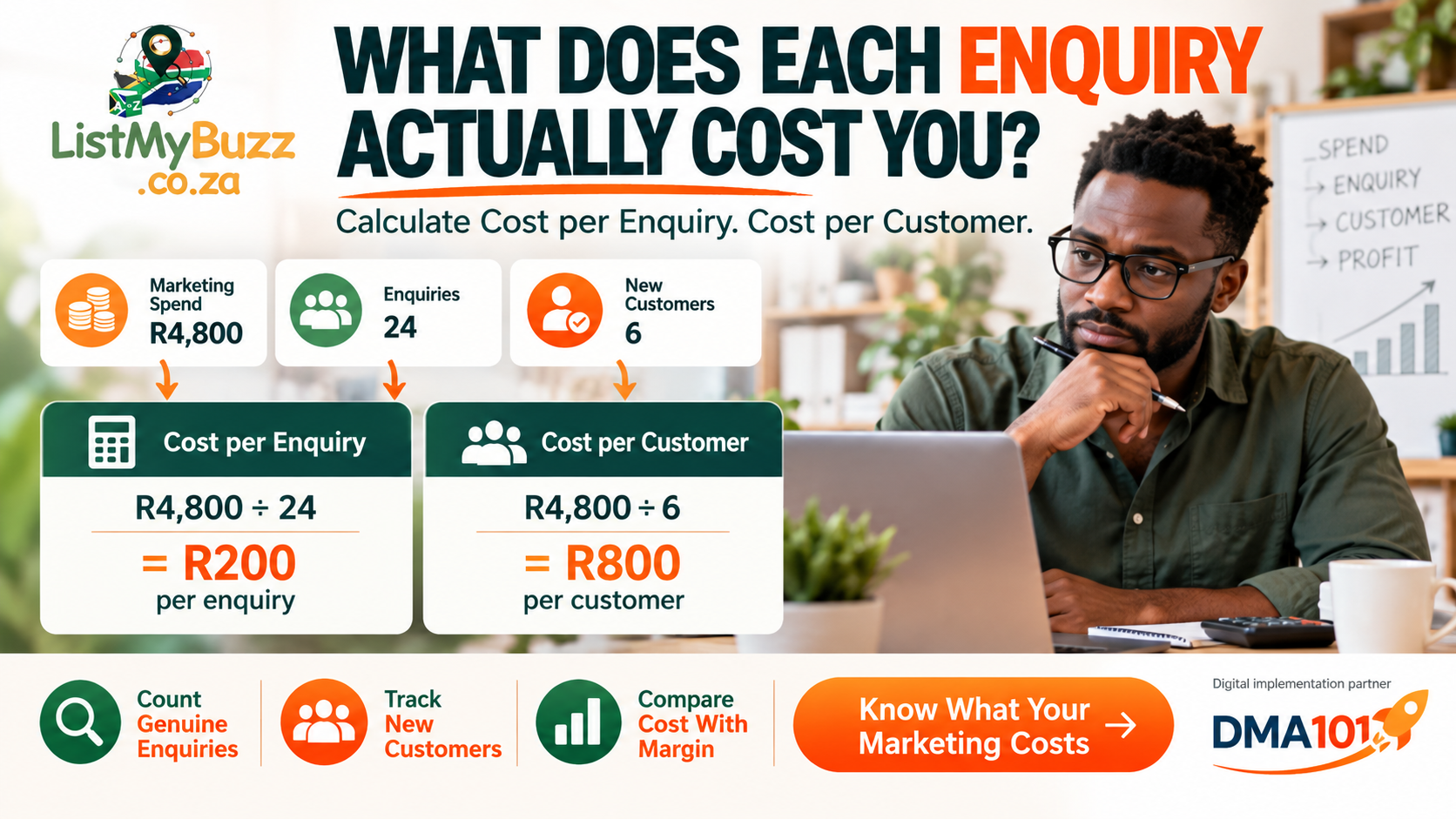
How to Calculate Your Cost per Enquiry and Cost per Customer
Calculate cost per enquiry and cost per customer, compare marketing channels and decide what you can afford to spend.
Read article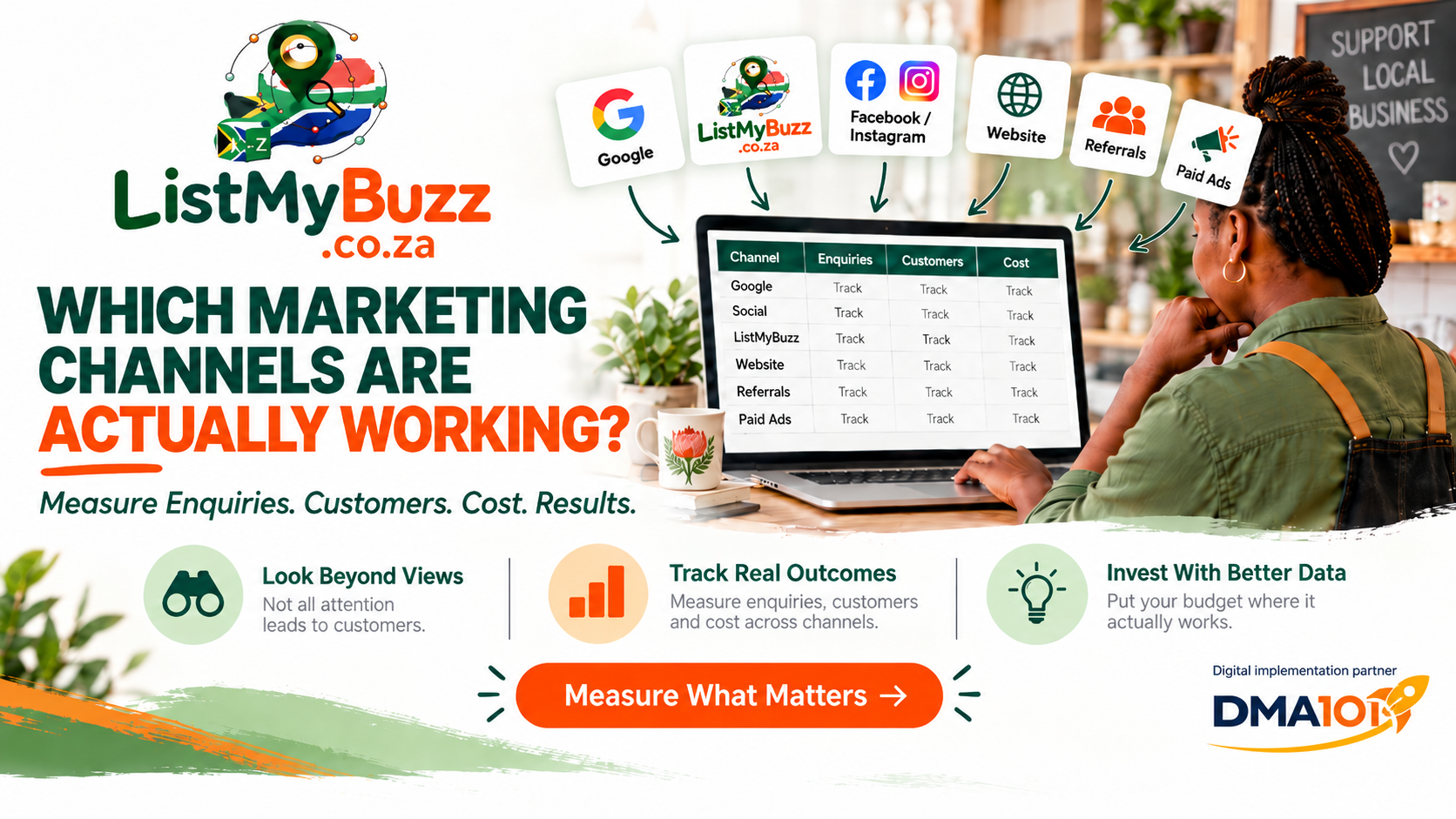
Which Marketing Channels Are Actually Working for Your Small Business?
Stop judging marketing by views alone. Compare enquiries, customer quality, costs, bookings and business outcomes.
Read article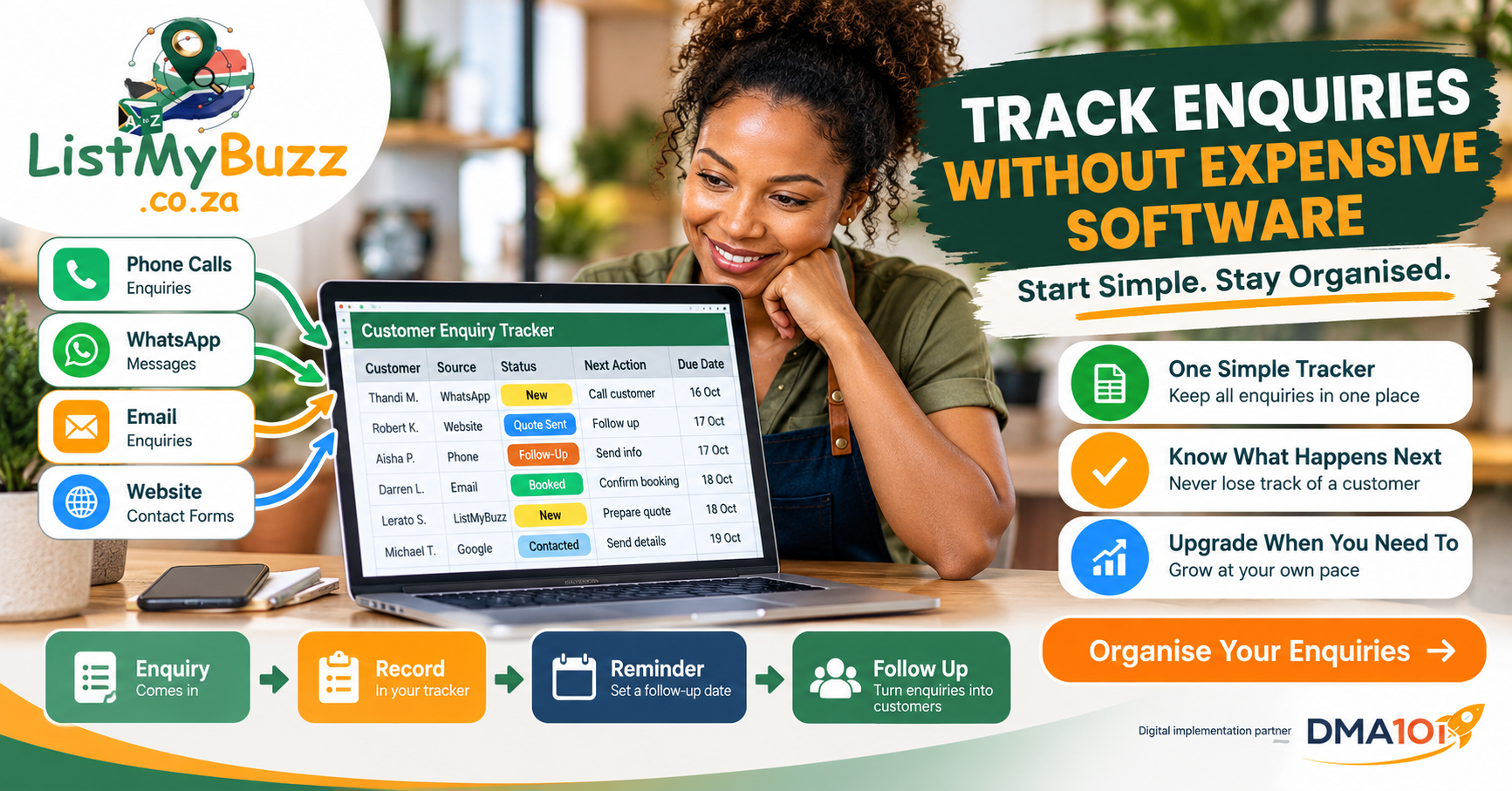
How to Track Customer Enquiries Without Expensive Software
You don't need an expensive CRM to start tracking customer enquiries properly — a spreadsheet and simple routine can take you far.
Read article