
Which Marketing Channels Are Actually Working for Your Small Business?
Google, Facebook, Instagram, referrals, directories, your website and paid advertising can all produce activity. The important question is which ones are producing useful business opportunities for you.
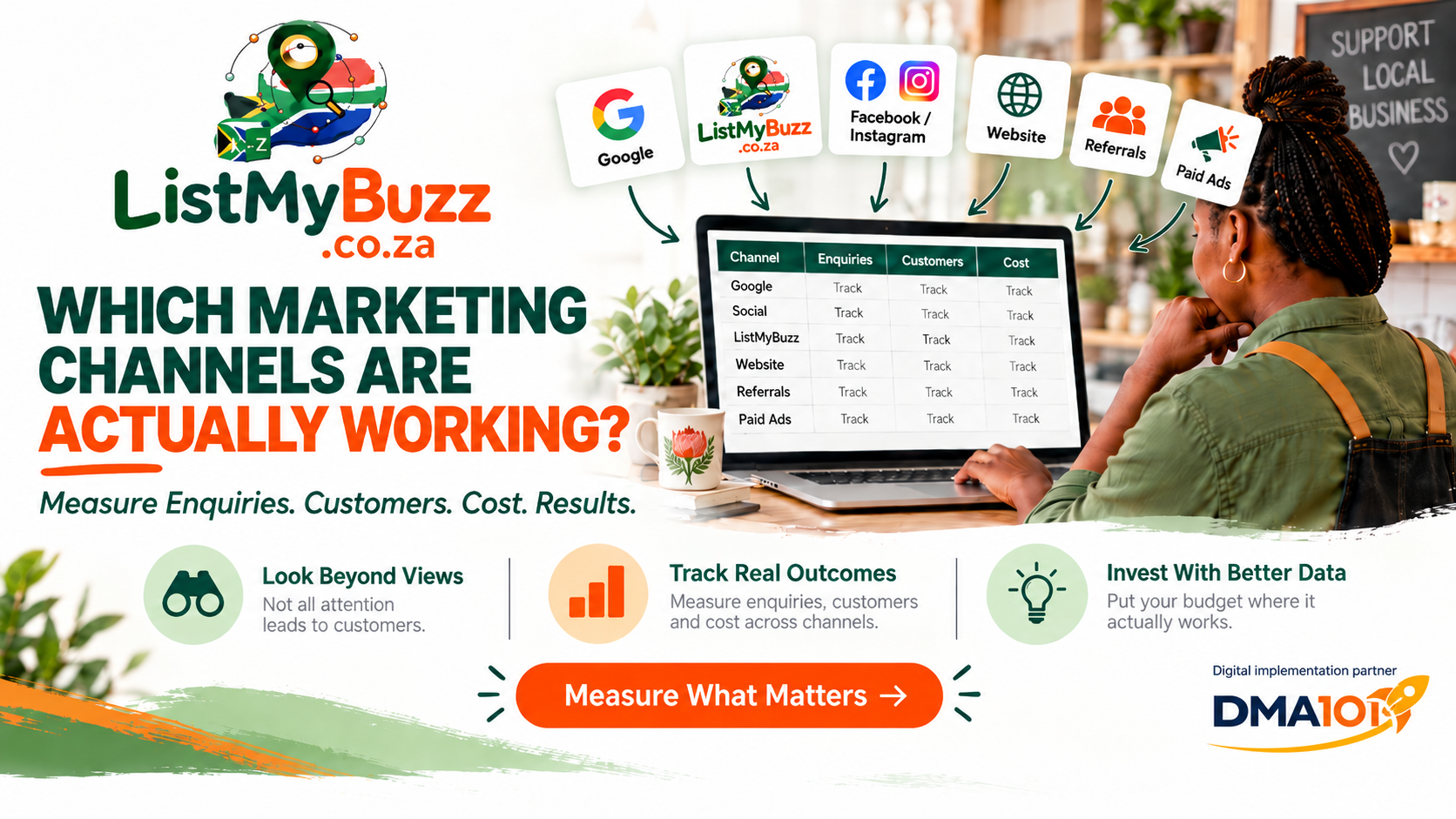
Your Facebook page has followers. Your website gets visitors. Your Google Business Profile gets views. People occasionally find you through referrals. You have a business directory listing. Maybe you're paying for Google Ads or Meta Ads too.
Everything appears to be doing something.
But when someone asks:
Which marketing channel is actually working?
you aren't sure.
This is a common problem.
Business owners often judge marketing by the numbers that are easiest to see:
Those numbers can be useful.
But they don't necessarily tell you whether the channel is helping to create suitable enquiries, quotations, bookings or customers.
The better question is:
What happened after the attention?
Quick answer
A marketing channel is worth paying attention to when it consistently produces outcomes that matter to your business at a reasonable cost in money and time.
Instead of comparing channels using views alone, look at:
There is no single "best" marketing channel for every South African small business.
A plumber in Benoni, boutique hotel in Cape Town, accountant in Pretoria and online retailer in Durban can have completely different customer journeys.
Your own data should guide the decision.
In this guide
- 1.What does "working" actually mean?
- 2.Why views and followers are not enough
- 3.The marketing channels worth measuring
- 4.The five numbers every small business should track
- 5.How to calculate cost per enquiry
- 6.How to calculate cost per customer
- 7.How to evaluate enquiry quality
- 8.How to compare free and paid channels fairly
- 9.How long should you test a channel?
- 10.How Google tools can help
- 11.How ListMyBuzz can fit into your channel mix
- 12.When to increase, reduce or stop marketing activity
- 13.A simple monthly marketing scorecard
- 14.When professional implementation can help
- 15.Marketing channel checklist
- 16.Frequently asked questions
- 17.The bottom line
First decide what "working" means
Marketing is not successful simply because people saw it.
Your definition of success should connect to your business goal.
Imagine two campaigns.
Channel A
Produces:
- 5,000 views
- 250 website visits
- 2 enquiries
Channel B
Produces:
- 500 views
- 40 website visits
- 7 relevant enquiries
Which performed better?
If your goal is awareness, Channel A may have value.
If your goal is customer enquiries, Channel B may deserve closer attention.
Neither answer is automatically correct.
The important thing is knowing what you're trying to achieve.
Start with the business outcome
Before looking at analytics, ask:
What do I want this channel to do?
Possible goals include:
| Goal | Useful measurement |
|---|---|
| Increase awareness | Reach, impressions, profile views |
| Drive website interest | Website visits, service-page visits |
| Generate enquiries | Calls, messages, forms, quote requests |
| Generate bookings | Completed bookings |
| Generate sales | Actual customers or purchases |
| Build repeat business | Returning customers |
| Generate referrals | Referred enquiries |
| Grow an email audience | Genuine subscriber growth |
A channel can perform well at one job and poorly at another.
Instagram may be useful for showcasing visual work.
Google Search may capture customers actively looking for a specific service.
Email may be more useful for existing customers.
Referrals may require almost no advertising spend but depend heavily on reputation and service delivery.
Judge the channel according to its actual purpose.
Views are signals, not customers
A view tells you that content or a profile appeared in front of someone.
A click tells you that someone took another step.
An enquiry tells you the person actively contacted the business.
A booking or accepted quotation tells you the conversation progressed further.
These stages should not be treated as interchangeable.
Seen
Stage 1Interested
Stage 2Visited
Stage 3Enquired
Stage 4Qualified
Stage 5Quoted / Booked
Stage 6Customer
Stage 7A person can drop out at any stage.
That is normal.
The mistake is assuming that a large number at the top guarantees results at the bottom.
Which marketing channels should you evaluate?
Most small businesses won't use all of these. Focus on the channels your business actually maintains.
Google Search and Google Maps
For local businesses, customers may discover you through Google Search or Maps. Google Business Profile's performance reporting can currently show interactions including calls made through the profile's call button, website clicks, direction requests, messages where available and bookings where supported.
These are useful indicators.
But a website click is not automatically a new customer.
Connect those interactions with your own enquiry records where possible.
Your website and organic search
Your website can perform several jobs:
Google Search Console can show how the website appears in Google Search, including impressions, clicks, queries and pages receiving search traffic. Google Analytics can then provide information about how people reached and interacted with the site.
That creates a useful distinction:
Search Console
How is the site performing in Google Search?
Analytics
Where are visitors coming from and what are they doing on the website?
Neither tool, by itself, tells you whether a phone caller eventually became a paying customer.
Your enquiry tracker fills that gap.
Business directories
Directories give customers another route to discover and understand your business. That channel can be particularly relevant to businesses that want another structured online profile with contact details, services, hours, images or enquiry options.
ListMyBuzz is positioned as a South African directory and business-growth platform that connects discovery with enquiries and selected growth tools.
Do not evaluate a directory only on profile views. Also ask:
Referrals and word of mouth
Referrals can easily become invisible in your marketing reports.
The customer simply phones.
You record:
Source: Phone
and the referral disappears.
But phone is not the discovery source.
Ask:
"How did you hear about us?"
If they say:
"My neighbour recommended you."
record:
Source: Referral
Over time, you may discover referrals play a larger role than your online dashboards suggest.
Organic social media
Facebook, Instagram, LinkedIn, TikTok and other social channels can play different roles. A visual business may use Instagram to showcase work. A professional B2B company may find LinkedIn conversations more relevant. A community-based service may use Facebook to remain visible locally.
The important thing is not whether the platform is popular. It is whether your relevant customers are using it in a way that supports your business goal.
Track more than likes.
Where practical, record:
Paid advertising
Paid advertising is easier to evaluate in one sense because you know how much money you spent. But it still requires proper tracking.
If you spend money on Google Ads or Meta Ads, you should ideally know what happens after the click. Was there:
Google Analytics currently uses key events for website or app actions that are important to the business. Those events can help evaluate which channels lead users to important actions. Google distinguishes these from advertising conversions used for campaign measurement and optimisation.
A paid channel may generate many clicks and still be poor value if very few of those visitors are relevant to your business.
Email and existing customers
Not all marketing is about finding strangers. Existing customers can be an important audience. Examples may include service reminders, product updates, useful newsletters, legitimate repeat-booking communication and customer follow-up.
Where you use email or electronic direct marketing, make sure your processes also comply with applicable privacy and marketing requirements.
From a measurement perspective, separate:
Track separately
Existing-customer activity
from
New-customer acquisition
Otherwise you may incorrectly credit a marketing campaign with a customer relationship that already existed.
Offline marketing still counts
A sign outside your shop. Vehicle branding. Flyers. Networking. Community events. Local sponsorships. Printed business cards.
These can produce enquiries too.
The challenge is that they don't automatically appear in Analytics.
Ask customers. For example:
"How did you hear about us?"
Possible answer:
"I saw your bakkie in Boksburg."
Record:
Source: Vehicle branding
Now offline marketing becomes measurable enough to identify patterns.
The five numbers every small business should track
You do not need a complicated analytics dashboard to compare channels.
Start with five numbers.
| Metric | What it helps you understand |
|---|---|
| Enquiries | How many people contacted you |
| Suitable enquiries | How many actually fit what you offer |
| Customers / bookings | How many progressed |
| Channel cost | What you spent |
| Value generated | What the resulting work was worth to the business |
Then add context.
Some channels cost money. Others cost mostly time.
Both costs matter.
1. Number of enquiries
Start with genuine enquiries.
Do not count:
as customer enquiries.
You want to know:
How many real people contacted us about potentially buying what we offer?
2. Suitable enquiries
Ten enquiries are not automatically better than three. Suppose eight of the ten are:
The three enquiries from another channel might all be highly relevant.
Add a simple field:
Suitable: Yes / No
or use outcomes such as:
This helps you compare quality as well as quantity.
3. Customers, bookings or accepted work
Eventually ask:
What happened?
Possible outcomes include:
That creates a chain:
Channel → Enquiry → Suitable → Customer outcome
This is much stronger than comparing follower counts.
How to calculate cost per enquiry
For paid marketing, use a simple calculation:
Cost per enquiry = channel spend ÷ genuine enquiries
For example, if an advertising channel costs R2,000 during a period and generates 10 genuine enquiries:
R2,000 ÷ 10 = R200 per enquiry
That example is purely illustrative. It is not a benchmark or recommended cost. Your acceptable cost will depend on:
How to calculate cost per customer
You can take the calculation one step further:
Cost per customer = marketing spend ÷ customers acquired
Using a fictional example:
Spend
R2,000
Customers attributed
4
Cost per customer
R500
Again, R500 is neither good nor bad without context. If the work produces very little profit, it may be too expensive. If each customer creates substantial profitable work, the channel may still be attractive.
Context matters.
Don't judge marketing by revenue alone
Suppose one channel produces R20,000 in sales. That sounds excellent.
But what if:
Advertising cost
R8,000
Materials
R7,000
Labour
R4,000
The headline revenue does not tell the whole story. Where possible, compare marketing activity with the economics of the work.
You don't necessarily need sophisticated accounting inside your marketing dashboard. You simply need to avoid confusing:
Revenue
with:
profitability
The ListMyBuzz Profit Margin Calculator can also help business owners understand margin, markup and basic break-even thinking when evaluating prices and business economics.
Use the Free Profit Margin CalculatorFree marketing isn't really free
Referrals may cost R0 in advertising.
Organic social media may cost R0 in platform fees.
Writing blog articles yourself may cost R0 in outsourced fees.
But your time still has value.
Suppose you spend:
Social media
10 hours per week creating social posts, receiving one low-quality enquiry per month.
Google Business Profile
One hour to maintain, producing several relevant calls.
That difference is worth noticing.
You don't need to put an exact rand value on every minute. But ask:
How much time does this channel require compared with what we get back?
Build a simple marketing channel scorecard
You can create a spreadsheet like this:
| Channel | Enquiries | Suitable | Customers | Spend | Time | Decision |
|---|---|---|---|---|---|---|
| Your data | Your data | Your data | Your data | Low/Med/High | Review | |
| ListMyBuzz | Your data | Your data | Your data | Your data | Low/Med/High | Review |
| Your data | Your data | Your data | Your data | Low/Med/High | Review | |
| Referrals | Your data | Your data | Your data | Your data | Low/Med/High | Review |
| Ads | Your data | Your data | Your data | Your data | Low/Med/High | Review |
Do not insert guessed data.
Use actual figures from your business.
After a useful measurement period, your decision column might become:
"Not working" may actually mean "poorly configured"
Be careful before abandoning a channel.
Suppose Google Ads produces no enquiries.
Possible explanation:
"Google Ads doesn't work for us."
But other explanations could include:
The channel may not be the only problem. The same is true of social media, websites and directories.
Before deciding a channel has failed, check the complete customer journey.
Diagnose where the problem occurs
Use this simple framework:
Nobody sees you
Possible issue: Visibility
People see you but don't click
Possible issue: Message or relevance
People click but don't enquire
Possible issue: Website, offer or contact journey
People enquire but aren't suitable
Possible issue: Targeting or positioning
Suitable people enquire but don't book
Possible issue: Price, availability, trust, sales process or follow-up
Use Google Analytics to compare website channels
Google Analytics currently provides acquisition reporting that helps website owners understand how new users and sessions arrive through channels, sources, mediums and campaigns.
For example, you might compare:
Then look at important website actions. Do visitors from one channel:
Website reporting can help, but remember that offline calls and later customer decisions may not be fully represented. Combine analytics with your enquiry tracker.
Use Google Business Profile performance carefully
Google Business Profile performance can currently provide data for interactions such as calls, direction requests, website clicks and certain bookings or messages. That can help answer:
Are people interacting with the profile?
But it still doesn't tell you automatically:
Did the caller become a customer?
Your customer tracker should record that outcome.
Search Console answers a different question
Search Console's Performance report shows how your website performs in Google Search and can report impressions, clicks, queries and landing pages. That makes it useful for questions such as:
It does not replace your enquiry tracker or accounting information. Use each tool for the question it is designed to answer.
Don't compare channels using different standards
This mistake is common.
You judge Facebook using:
Likes
Google using:
Calls
your website using:
Visits
and referrals using:
Customers
Then you conclude one channel is better.
That comparison isn't fair.
Where possible, bring them to a common measurement level. For example:
| Channel | Relevant enquiries | Customers | Cost |
|---|---|---|---|
| Channel A | Your data | Your data | Your data |
| Channel B | Your data | Your data | Your data |
| Channel C | Your data | Your data | Your data |
Now you are comparing similar outcomes.
How long should you test a channel?
One week may be enough to detect an obvious technical problem. It is often not enough to confidently decide whether a marketing channel deserves a permanent place in your strategy.
Some customers decide quickly. Others take longer.
Seasonality may matter. Paydays may matter.
Weather may matter for some trades.
School holidays may affect tourism or family businesses.
Business-to-business buying cycles may take longer than consumer purchases.
The right test period depends on the business.
Avoid making major decisions based on a tiny sample unless the issue is clearly broken.
Small sample sizes can mislead you
Imagine this month:
Channel A
1 enquiry, 1 customer
Channel B
8 enquiries, 2 customers
Channel A has a perfect-looking conversion rate. Does that prove it is superior?
No.
One customer is too little evidence for a confident conclusion. Look for patterns over time.
The aim is not mathematical perfection. It is better decision-making.
Don't spread your marketing too thin
A small business can easily end up trying to maintain:
That may be too much.
If you cannot maintain, measure and respond properly, having fewer well-managed channels may be more practical.
Use your data to decide where your limited resources deserve attention.
A simple decision framework
For each channel, ask five questions:
Does it produce relevant enquiries?
Not just visibility.
Do some of those enquiries become customers?
Track outcomes.
Is the cost reasonable for the value created?
Include money and time.
Can we maintain the channel consistently?
A channel that consumes all your time may not be sustainable.
Can we identify a realistic improvement?
Before abandoning it, ask whether there is an obvious problem you can fix.
That gives you four possible decisions:
An example for a local service business
Imagine a plumbing company in Gauteng reviewing three months of its own data. This example is fictional and exists only to show the method.
Produces regular relevant calls. Some become booked jobs. The business spends little direct money maintaining the profile.
Possible decision: Maintain and improve.
Produces plenty of engagement but very few service enquiries. Creating posts takes significant staff time.
Possible decision: Reduce posting frequency or test a clearer enquiry strategy.
Referrals
Produce fewer total enquiries but most are within the correct service area and understand what the business offers.
Possible decision: Protect the customer experience and make referrals easy.
Paid ads
Produce several enquiries but many are outside the intended job type.
Possible decision: Improve targeting before increasing budget.
Notice that none of these conclusions is "Google is always best." The recommendation comes from that specific business's data.
Where ListMyBuzz fits into your marketing mix
ListMyBuzz gives South African businesses another structured discovery channel, with listing, contact and enquiry functionality depending on the selected package. Its broader platform is designed around discovery, customer contact, follow-up and growth tools.
That means ListMyBuzz should be evaluated like any other marketing channel:
If you haven't created your profile yet, you can add your business to the directory and include it in your channel tracking.
Use Growth Tools when tracking starts becoming fragmented
As enquiry volume grows, you may find that the marketing data is spread across Google, social media, website forms, phone calls, WhatsApp, email and business-directory enquiries.
A simple spreadsheet can still work.
But a CRM or connected customer process can make it easier to track:
When professional marketing support may help
At some point, the challenge may become more technical. You might need to connect:
That is where professional setup can make sense.
Where DMA101 can assist
Businesses that need a broader marketing measurement and implementation system can get professional support from DMA101. DMA101's current services include Google Ads and Meta Ads, conversion tracking, CRM setup, lead tracking and attribution, website and landing-page work, workflow automation and broader digital-growth systems.
This is particularly relevant when your question changes from:
Which channel seems to be working?
to:
How do we connect our advertising, website, CRM and customer outcomes so that we can measure them properly?
A simple monthly marketing review
Once a month, put your main channels into one table.
| Channel | Enquiries | Suitable | Customers | Spend | Time | What will we do? |
|---|---|---|---|---|---|---|
| Actual | Actual | Actual | Actual | Low/Med/High | Keep / Improve | |
| ListMyBuzz | Actual | Actual | Actual | Actual | Low/Med/High | Keep / Improve |
| Referrals | Actual | Actual | Actual | Actual | Low/Med/High | Keep / Improve |
| Actual | Actual | Actual | Actual | Low/Med/High | Keep / Improve | |
| Paid Ads | Actual | Actual | Actual | Actual | Low/Med/High | Keep / Improve |
Then ask:
That conversation is far more useful than: "Facebook got lots of likes."
Marketing channel checklist
Before deciding whether a channel works, check:
Measurement
Enquiry quality
Customer outcomes
Channel costs
Decision-making
Frequently asked questions
The bottom line
The marketing channel with the most views is not automatically the channel helping your business most.
Look deeper. Track:
Use Google Analytics, Search Console, Business Profile reporting and platform dashboards where they provide useful information.
But connect those metrics to your own customer records.
The goal isn't perfect marketing attribution.
The goal is to know enough to make better choices about where your next rand and your next hour should go.
Make your marketing easier to track
ListMyBuzz gives South African businesses another structured discovery and enquiry channel, with additional reporting and growth functionality depending on the selected package.
Marketing channels, listings, websites, analytics and advertising do not guarantee enquiries, customers, sales or revenue. Results depend on your market, location, offer, pricing, competition, implementation and customer response.
Related articles
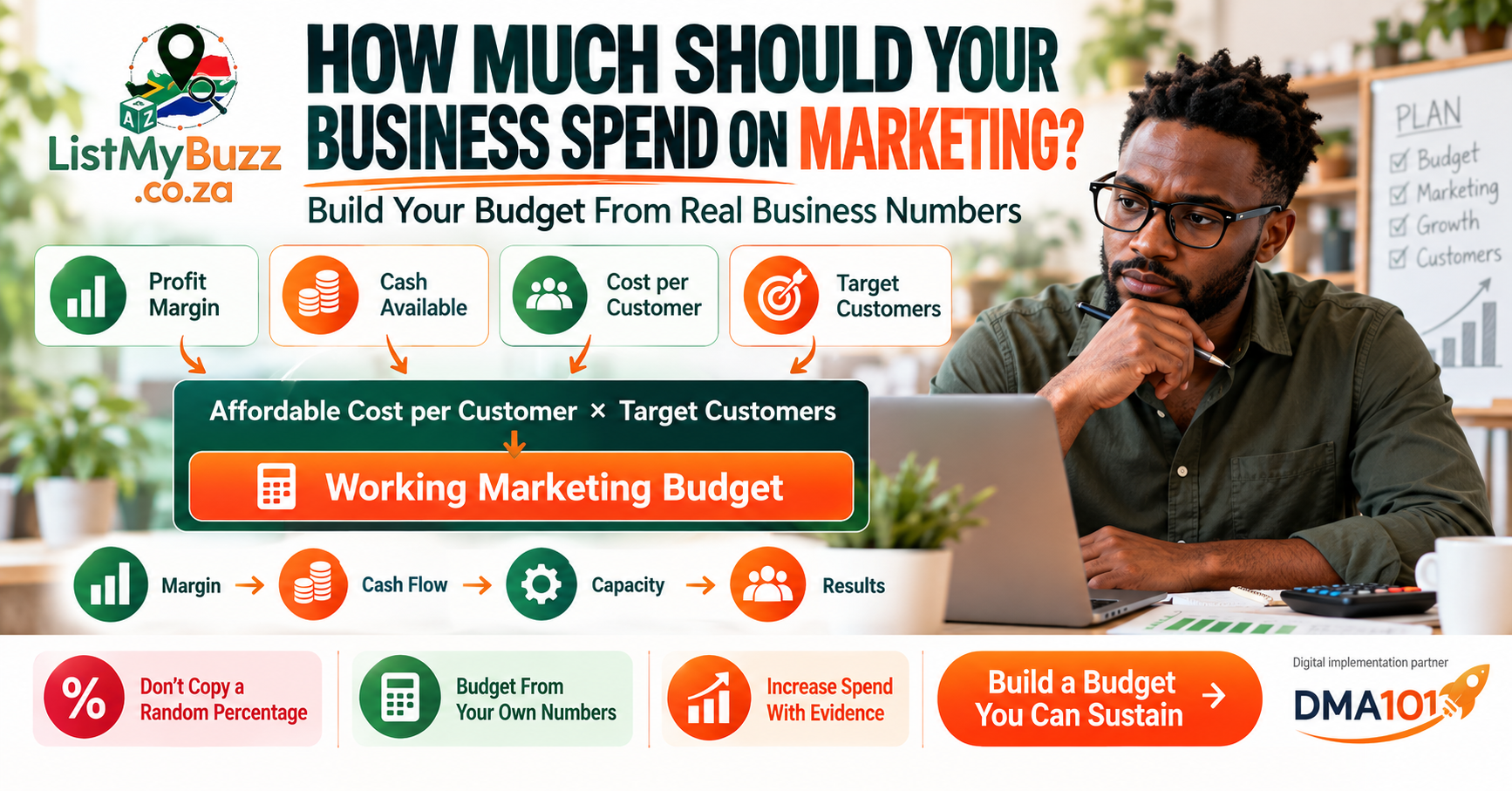
How Much Should a Small Business Spend on Marketing?
Set a realistic marketing budget using your margins, cash flow, customer costs, growth goals and channel results.
Read article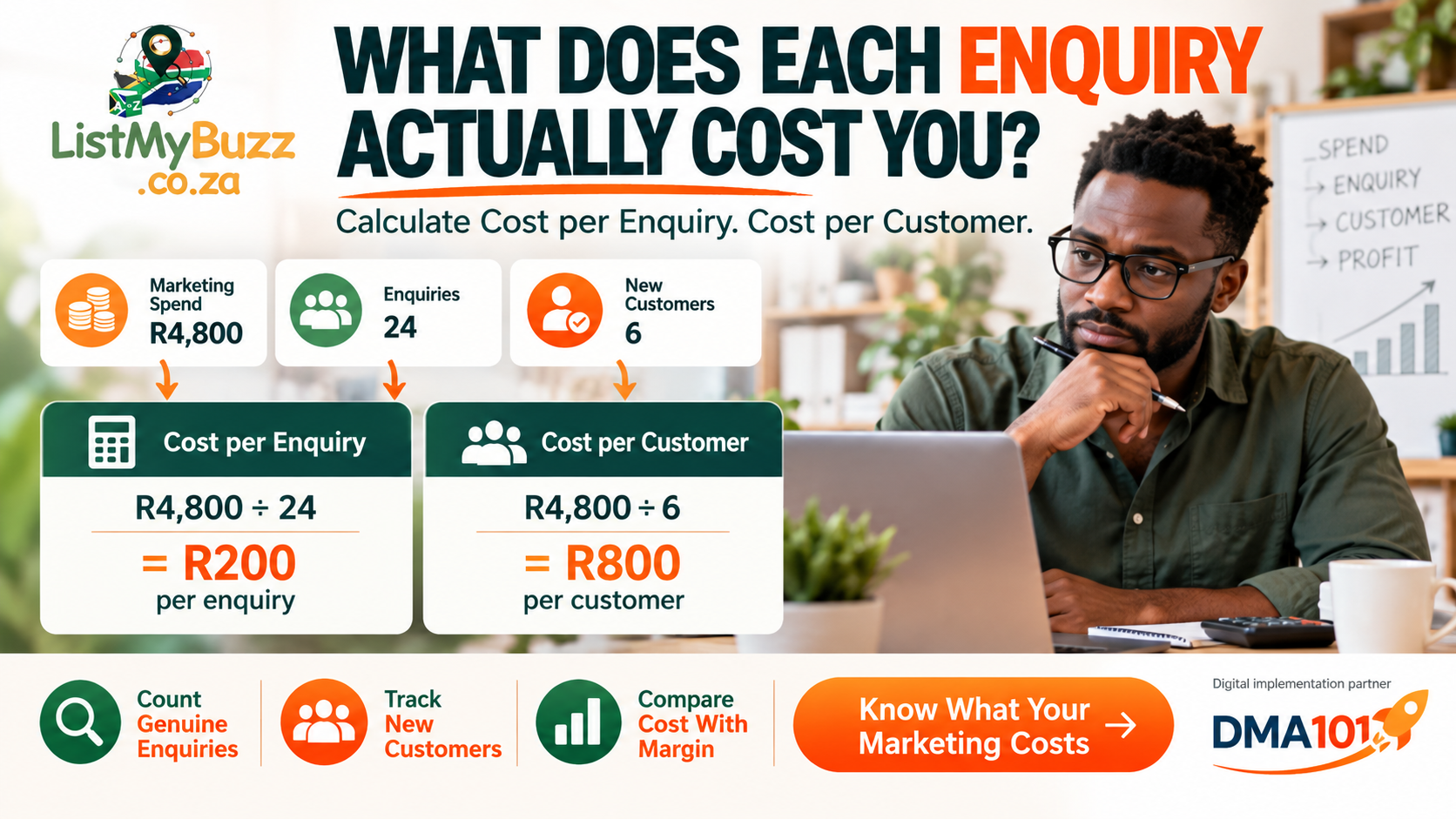
How to Calculate Your Cost per Enquiry and Cost per Customer
Calculate cost per enquiry and cost per customer, compare marketing channels and decide what you can afford to spend.
Read article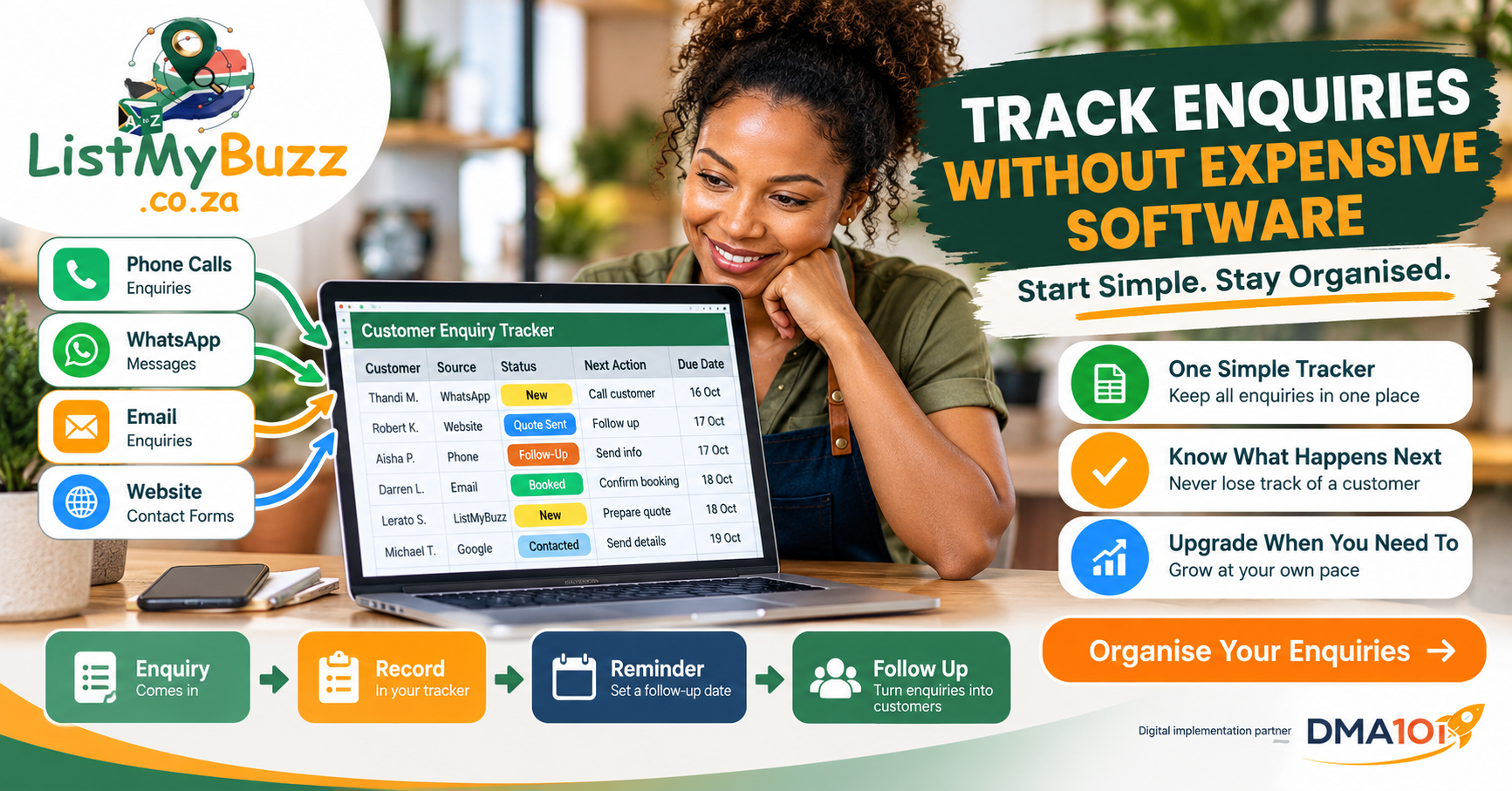
How to Track Customer Enquiries Without Expensive Software
You don't need an expensive CRM to start tracking customer enquiries properly — a spreadsheet and simple routine can take you far.
Read article